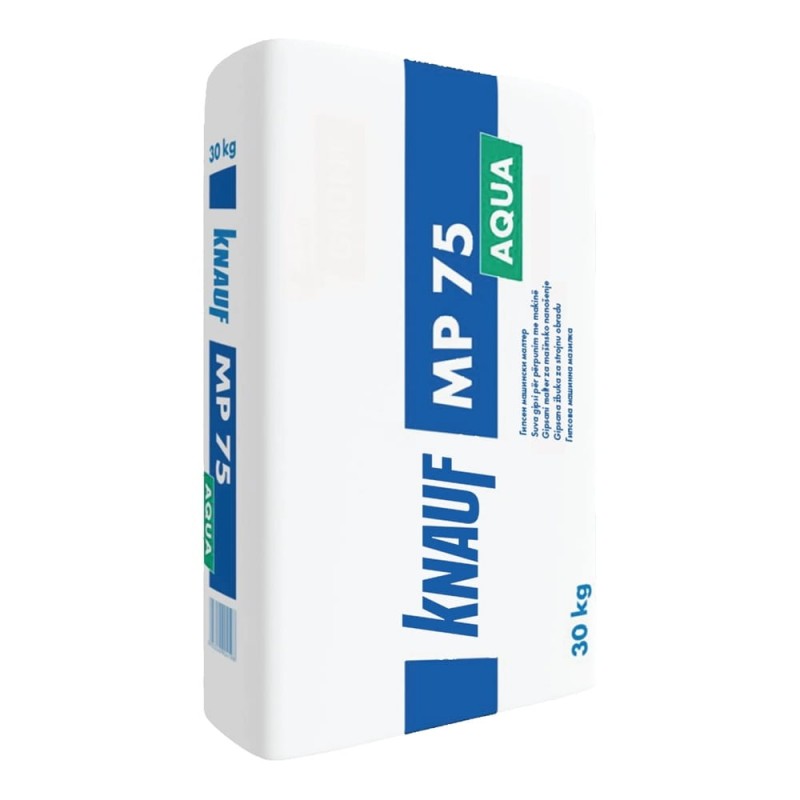
KNAUF MP 75 Aqua Gypsum Plaster for Wet Rooms, 30 kg
KNAUF MP 75 Aqua 30 kg is a lightweight gypsum plaster with water-repellent additives, developed for levelling interior walls and ceilings in rooms with elevated humidity. The factory-prepared dry mix combines reduced water absorption, easy workability and the ability to create an even substrate for subsequent painting or ceramic tiling.
The product is designed for machine and hand application. This makes it suitable for covering large areas in new construction as well as renovation work in individual rooms. With a properly prepared substrate and correct application, the plaster provides a stable levelling layer suitable for rooms with periodically elevated humidity.
The hydrophobic additives reduce the material’s water absorption. However, moisture resistance does not make the plaster a waterproofing membrane: areas exposed to direct water contact require an appropriate waterproofing system, selected according to the intended use of the area and the chosen finish.
Main Benefits of KNAUF MP 75 Aqua
- Reduced water absorption thanks to the hydrophobic additives in the mix.
- Suitable for humid interior rooms when the specified service conditions are observed.
- For walls and ceilings, with the application method and thickness adapted to the substrate.
- Machine or hand application depending on the area, equipment and workflow.
- Easy spreading and levelling to prepare surfaces for subsequent finishes.
- Suitable as a substrate for ceramic tiling up to 40 kg/m², provided the preparation and tiling requirements are met.
- Non-combustible material with reaction-to-fire class A1.
- Approximately 180 minutes of working time, depending on the substrate and working conditions.
- Approximate consumption of 9 kg/m² at a thickness of 10 mm, allowing material quantities to be estimated in advance.
- Practical 30 kg packaging for professional construction and renovation work.
Where Can This Gypsum Plaster Be Used?
KNAUF MP 75 Aqua is designed for interior rooms, from basement to attic. It is suitable for residential and public buildings, hotels and other projects requiring gypsum plaster with enhanced moisture resistance.
The material can be used in rooms with relative air humidity of up to 85% for up to 10 hours per day. This condition is important when choosing the plaster: suitability for periodically elevated humidity does not imply suitability for permanently wet environments or continuous contact with water.
Examples of applications, subject to the specific conditions, include:
- Bathrooms and sanitary facilities in residential buildings.
- Kitchens and utility rooms with periodically elevated humidity.
- Sanitary areas in hotels and other accommodation facilities.
- Suitable interior rooms in hospitals and public buildings.
- Basements and other interior spaces where the substrate is suitable for plastering and there is no unresolved issue with penetrating moisture.
- Walls intended for subsequent ceramic tiling.
- Ceilings, provided the specific restrictions on thickness and substrate moisture are observed.
The product is intended for interior use. It should not be selected as a façade plaster or as a solution for exposed outdoor surfaces subject to weathering.
Technical Specifications
Main technical specifications of KNAUF MP 75 Aqua 30 kg
| Property |
Value / Description |
| Product type |
Lightweight dry gypsum plaster with additives for reduced water absorption |
| Intended use |
Interior walls and ceilings, including in humid rooms |
| Application method |
Machine or hand application |
| Pack weight |
30 kg |
| Working time |
Approximately 180 minutes, depending on the substrate and conditions |
| Approximate consumption |
Approximately 9 kg/m² at a layer thickness of 10 mm |
| Approximate coverage per bag |
Approximately 3.3 m² at a thickness of 10 mm, calculated without application losses |
| Minimum thickness |
8 mm |
| Typical average thickness |
10 mm |
| Maximum thickness on walls |
Up to 50 mm; a two-coat application is used for thicknesses above 35 mm |
| Thickness on concrete ceilings |
Up to 15 mm for standard single-coat application |
| Application temperature |
At least +5 °C for the room and building elements under standard application conditions |
| Permissible relative humidity in service |
Up to 85% for up to 10 hours per day |
| Ceramic tiling |
Permissible surface loading of up to 40 kg/m², subject to the manufacturer’s requirements |
| Reaction-to-fire class |
A1 – non-combustible material |
| Gypsum plaster type |
B4 in accordance with EN 13279-1 |
| pH value |
Approximately 11 |
| Water vapour diffusion resistance factor, μ |
8 |
| Approximate drying rate |
Approximately 1 mm per day under normal conditions |
| Storage |
Approximately 6 months under suitable conditions; check the shelf life and instructions on the packaging |
Substrate Preparation Before Plastering
Proper substrate preparation is essential for adhesion and consistent plaster performance. Before application, the surface must be sound, stable and free from dust, dirt, loose particles and residues that could impair bonding.
Remove major irregularities and check the condition of existing coatings. Do not apply the new layer over crumbling areas or coatings with insufficient adhesion. Exposed metal and reinforcing elements must be protected against corrosion before plastering.
Concrete Surfaces
Smooth concrete requires thorough removal of formwork oil residues and other release agents. For non-absorbent concrete surfaces, use a suitable bonding primer, such as Knauf Betokontakt, in accordance with its instructions.
With standard preparation, the maximum residual moisture content of the concrete must be no more than 3% by mass. When Knauf Spraykontakt is used, the technical instructions allow up to 4% under the specified conditions. The special requirements for concrete ceilings must be considered separately.
Highly Absorbent and Unevenly Absorbent Masonry
Where the substrate absorbs water too quickly or has varying absorbency across different areas, a primer that regulates absorbency is required. Specified options include Knauf Grundiermittel and Knauf Aufbrennsperre. Product selection, dilution and waiting time depend on the substrate and the instructions for the particular primer.
Existing Gypsum and Gypsum-Lime Plasters
Existing plaster must be checked for soundness. Remove unsuitable coatings, deposits and unstable areas, then apply the necessary primer, such as Knauf Tiefengrund. Priming does not replace the removal of deteriorated or poorly bonded layers.
Hand and Machine Application
KNAUF MP 75 Aqua allows the application method to be selected according to the project. Machine application is practical for large areas and continuous work across several rooms. Hand application also makes the product suitable for smaller renovation areas.
Mix preparation and water quantity must follow the instructions on the packaging and in the current technical documentation. The correct consistency is important for even application and subsequent screeding. Use clean containers and tools, and do not introduce additives that are not specified for the mix.
For machine application, settings must be matched to the equipment and delivery hose. According to the technical instructions, breaks during application must not exceed 15 minutes. For longer interruptions, flush the machine and hose with water to prevent the material from setting inside them.
Application and Finishing Sequence
- Application: distribute the material over the prepared substrate, maintaining the required thickness.
- Initial levelling: level the plaster with an H-profile straightedge, working vertically and horizontally.
- Surface correction: once the plaster begins to set, work the surface with a trapezoidal straightedge.
- Preparation for a smooth finish: where appropriate for the intended finish, dampen with a foam sponge and even out minor irregularities.
- Smoothing: once the plaster has set sufficiently, use a wide finishing spatula or trowel.
- Junction detailing: separate the plaster at adjoining structures and junctions by making a suitable separating cut or using a separation strip, such as Knauf Trenn-Fix.
Important: finishing depends on the next coating. Surfaces intended for ceramic tiling must be left rough and must not be smoothed or sponge-floated as they would be for painting.
Layer Thickness on Walls
The minimum plaster thickness is 8 mm, and the typical average thickness is 10 mm. Layers up to 50 mm can be applied to walls, with a two-coat application required for thicknesses above 35 mm, in accordance with the manufacturer’s method.
Thicker layers require more material and longer drying times. For significantly uneven walls, it is therefore useful to measure deviations in advance rather than calculating quantities solely from the nominal consumption at 10 mm.
When covering service chases, provide at least 5 mm of plaster cover over the chase, while also observing the general requirements for the layer and substrate.
Reinforcement on Mixed Substrates
When different materials meet within the same surface, such as brickwork and concrete, individual areas may behave differently. In these cases, the technical instructions call for reinforcement with fibreglass mesh. This method also applies to the relevant insulation boards.
The mesh is positioned in the upper third of the plaster layer, with adjacent sheets overlapping by at least 100 mm. Application is carried out in two passes using the “wet-on-wet” method, so that the first layer has not hardened when the second is applied.
Reinforcement must be planned as part of the application. It does not replace required structural movement joints or eliminate the cause of active cracks or substrate movement.
KNAUF MP 75 Aqua as a Substrate for Tiles
One practical application of the product is preparing walls for ceramic tiling. The plaster is suitable for surface loading of up to 40 kg/m², provided the manufacturer’s requirements are followed and a suitable system of primer, waterproofing where required, and adhesive is selected.
Before tiling, the substrate must be:
- Sufficiently dry and adequately strong.
- Even and stable.
- Free from dust, frozen areas and cracks.
- Rough-textured, without smoothing or sponge floating.
- Prepared with a suitable primer for the tiling system.
The technical information identifies Knauf Spezialhaftgrund, diluted at a ratio of 1:2, as an option for improving adhesion. The suitability of this approach must be checked against the current instructions for the primer and the selected adhesive.
For tiles and slabs larger than 30 × 60 cm, the manufacturer specifies fast-setting tile adhesives complying with the applicable EN 12004 standard. With large-format tiles, checks must cover not only dimensions but also tile weight, wall flatness and compatibility between all layers.
Is Waterproofing Required Under the Tiles?
The water-repellent properties of MP 75 Aqua do not remove the need for waterproofing wherever it is required. In areas exposed to direct water spray, such as around a shower, corners, pipe penetrations and junctions must be detailed as part of an appropriate waterproofing system.
Application to Concrete Ceilings
Separate restrictions apply to concrete ceilings. Standard application consists of a single coat no thicker than 15 mm. The general maximum thickness for walls must not automatically be applied to ceilings.
Do not plaster a concrete ceiling if residual moisture exceeds 3%, the substrate temperature is below +5 °C, or condensation is present on the surface. These conditions must be checked before work begins.
Where a thicker layer is required or a special application using PutzPin is being considered, the solution must follow Knauf’s specific system instructions. Exceptions for such systems do not constitute general permission to apply plaster to damp or cold concrete.
For a ceiling beneath a flat roof, the necessary thermal insulation and waterproofing must be installed, and the ceiling plaster must be correctly separated from the walls.
Working Time and Application Conditions
The approximate working time is 180 minutes. This depends on the substrate and site conditions and should not be assumed to remain identical at every temperature or level of absorbency.
For standard application, the temperature of the room and building elements must be at least +5 °C. Protect freshly applied plaster from freezing until it is completely dry.
Plan the working area so that application, levelling and subsequent finishing can be completed at the appropriate stages. Organisation is especially important for machine application and large continuous surfaces.
Drying and Preparation for Subsequent Layers
Under normal conditions, the approximate drying rate is 1 mm of thickness per day. This is a general guide rather than a guaranteed waiting period before painting or tiling.
Actual drying depends on:
- The thickness of the applied layer.
- Air temperature and relative humidity.
- Air exchange and ventilation.
- Substrate absorbency and moisture content.
- The overall amount of construction moisture in the room.
High humidity, low temperatures or insufficient ventilation will extend the drying time. Ensure good ventilation and proceed with subsequent finishes only when the substrate meets their requirements.
Working time and drying time are different properties. Once the working period has ended, the plaster is not necessarily ready to receive a finishing coat.
Painting and Final Finishing
To achieve a smooth surface for painting, the technical instructions specify a suitable finishing material, such as Knauf Super Finish, taking account of the complete system and conditions in the room.
Before finishing, the plaster must be dry, stable and free from dust. Select the primer according to the intended coating; specified options include the deep-penetrating primer Knauf Tiefengrund.
In rooms with elevated humidity, use paint intended for those conditions. A plaster with reduced water absorption must be complemented by an appropriate final coating and correctly executed details. Alkyd paints are excluded from the suitable paints identified in the technical information.
Consumption and Calculating the Required Quantity
The average approximate consumption of KNAUF MP 75 Aqua is 9 kg/m² at a thickness of 10 mm. At this thickness, one 30 kg bag covers approximately 3.3 m², excluding application losses and additional material needed to level irregularities.
For an initial calculation at a thickness of 10 mm, use the following formula:
Required quantity in kg = area in m² × 9 kg/m².
Example quantities at a thickness of 10 mm, excluding application losses
| Area |
Calculated Quantity |
30 kg Bags, Rounded Up |
| 10 m² |
90 kg |
3 bags |
| 20 m² |
180 kg |
6 bags |
| 30 m² |
270 kg |
9 bags |
| 50 m² |
450 kg |
15 bags |
The table provides a mathematical estimate. The actual quantity must be determined according to the measured average thickness, wall condition and application losses. Thicker layers require more material.
Non-Combustible Material with Class A1
KNAUF MP 75 Aqua has reaction-to-fire class A1. This is a property of the material and is different from the fire resistance of a complete wall, ceiling or other construction.
Where the plaster forms part of a solution with specific fire protection requirements, the thickness, substrate and all other components must comply with the project specification and system requirements.
Bag Storage
Store the product in a dry place on wooden pallets, protected from moisture. The approximate storage period is 6 months under the specified conditions; check the packaging for the specific shelf life and requirements.
Damaged or torn bags must be sealed airtight, and their contents used first. Check the condition of the mix before use. Material that has become damp or started to set should not be considered equivalent to correctly stored dry product.
Practical Tips for Good Results
- Check the source of moisture. Plaster with reduced water absorption does not resolve leaks, rising damp or condensation problems.
- Match the primer to the substrate. Smooth concrete and highly absorbent masonry require different preparation.
- Decide on the final finish in advance. Preparation for tiling differs from finishing for painting.
- Check the thickness across the entire area. Deep deviations increase consumption and extend drying time.
- Observe the separate requirements for ceilings. The permissible thickness on walls does not automatically apply overhead.
- Reinforce where necessary. Pay attention to transitions between different building materials.
- Allow sufficient drying time. Do not schedule the next coating solely according to the number of calendar days elapsed.
- Use a compatible system. The primer, waterproofing, adhesive and finishing coat must be suitable for gypsum substrates and the conditions in the room.
Frequently Asked Questions
Is KNAUF MP 75 Aqua suitable for bathrooms?
Yes, provided the permissible humidity conditions are observed and the complete system is correctly installed. Areas exposed to direct water contact require appropriate waterproofing beneath the tiling.
Can the plaster be used outdoors?
The product is intended for interior rooms. For façades and exposed areas, choose a material expressly designed for the intended outdoor application.
Is the plaster waterproof?
MP 75 Aqua is a hydrophobic gypsum plaster with reduced water absorption and enhanced moisture resistance. This does not mean that it can replace waterproofing or be used without restrictions under permanently wet conditions.
How many square metres does one 30 kg bag cover?
At a thickness of 10 mm and consumption of approximately 9 kg/m², calculated coverage is around 3.3 m². Actual coverage depends on the substrate, thickness and application losses.
Can it be applied by hand?
Yes. KNAUF MP 75 Aqua is designed for both machine and hand application.
Can tiles be bonded to it?
Yes, with permissible surface loading of up to 40 kg/m² and compliance with the requirements for the substrate and tiling system. Leave the plaster rough, without smoothing or sponge floating.
How long does it need to dry?
The guide is approximately 1 mm per day under normal conditions. The actual time may be longer with high humidity, low temperatures, thick layers or insufficient ventilation. Readiness is determined by the requirements of the subsequent coating.
Can it be used on a ceiling?
Yes, but standard single-coat application on concrete ceilings is limited to 15 mm and requires compliance with the restrictions on residual moisture, temperature and absence of condensation.
What is the difference between the 180-minute working time and drying time?
Working time indicates the approximate period available for applying and finishing the material. Drying continues afterwards and is necessary before paints, tiling and other coatings can be applied.
KNAUF MP 75 Aqua 30 kg is a practical choice for levelling interior walls and ceilings where a gypsum plaster with reduced water absorption, hand or machine application and suitability for subsequent ceramic tiling is required. Proper substrate preparation, correct thickness and sufficient drying are essential to the quality of the finished surface.